
 ZH
ZH  EN
EN 

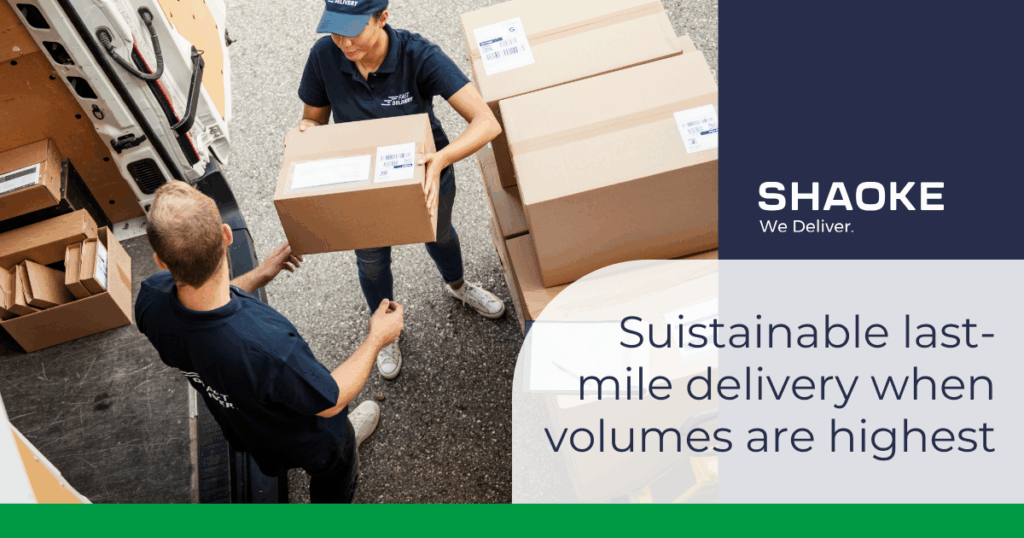
Last-mile delivery is one of the most polluting and most expensive parts of the logistics chain. During peak season, the impact becomes even larger: more vans on the road, denser routes, and higher customer expectations. Studies show that last-mile delivery can account for up to 40–50% of total logistics emissions and nearly half of all delivery costs in urban areas (World Economic Forum; McKinsey Urban Mobility Analysis). When volumes surge, cities face more congestion, and delivery networks become less predictable.
Despite the pressure, there are effective ways to cut emissions and waste without slowing down the operation.
The peak-season problem: more stops, more traffic, more emissions
During peak months, parcel volumes can increase by 30-60% depending on the market (Ecommerce Europe 2024 Report). This leads to more vans dispatched, shorter planning cycles, and inefficient routing. On bad days, congestion alone can raise fuel consumption by 20-30% (International Transport Forum). With so many deliveries concentrated in short time windows, the challenge is not only speed, it’s how to handle this speed with fewer environmental consequences.
Choosing the right fleet mix: electric, hybrid, or low-emission
Switching to electric vans is one of the most direct ways to reduce emissions, especially in cities where daily routes are short. Research shows that electric vans can cut last-mile CO₂ emissions by up to 70-90% depending on the grid (European Environment Agency). Hybrids or low-emission vehicles help in semi-urban areas where charging networks are still limited. Even partial fleet transitions, for example, assigning EVs to the densest city routes, make a noticeable difference during peak season.
Better route planning: fewer miles, same workload
Route optimization has more impact during peak than during any other period. High-density delivery days create more opportunities to group stops efficiently. Modern planning tools can reduce total distance by 10-20% (Deloitte Logistics Optimization Study).
Common improvements include:
- prioritizing micro-clusters of deliveries,
- avoiding repeated stops in the same street,
- spreading peak-day deliveries across early morning or evening windows.
This lowers emissions and reduces driver stress at the same time.
Using micro-hubs and local drop-off points
Micro-hubs allow carriers to shift part of the workload closer to customers, reducing long inner-city routes. A study on European urban logistics shows that micro-hubs combined with cargo bikes can reduce last-mile CO₂ by 60-80% in dense areas (EIT Urban Mobility).
Parcel lockers, pickup points, and neighborhood hubs also reduce repeat delivery attempts, a common source of unnecessary emissions during peak.
What companies gain from greener last-mile planning
Focusing on greener operations isn’t only about emissions. Companies that apply cleaner vehicle choices, optimized routes, and local delivery hubs often see measurable benefits: fewer failed deliveries, lower fuel costs, more predictable shifts, and better relations with city authorities. During peak season, when pressure is highest, these gains help stabilize operations and reduce unnecessary mileage.
Sources
- World Economic Forum — “The Future of the Last Mile.”
- McKinsey Urban Mobility Analysis — Last-mile cost and emission breakdown.
- Ecommerce Europe Report 2024 — Peak-season delivery volume data.
- International Transport Forum — Urban congestion and fuel consumption impact.
- European Environment Agency — Emission savings from electric vans.
- Deloitte Logistics Optimization Study — Impact of route optimization tools.
- EIT Urban Mobility — CO₂ reduction through micro-hubs and cargo bikes.