
 ZH
ZH  EN
EN 

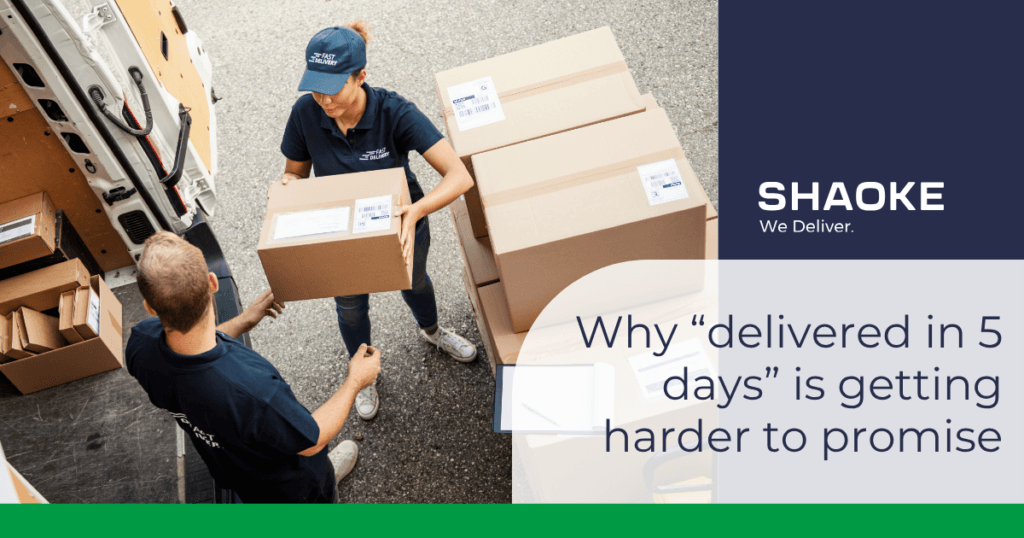
For a long time, “5-day delivery” was a safe promise for cross-border e-commerce. It gave customers clarity and was still realistic for logistics teams to deliver. That balance is shifting. What used to be a relatively predictable flow ,from origin to doorstep, is now affected by delays that are harder to control or even anticipate.
One of the main drivers is ongoing disruption on key trade routes. The situation around the Suez Canal continues to impact Asia-Europe shipping, with vessels rerouting around Africa to avoid risk. That adds significant transit time and reduces available capacity, since ships are tied up longer per journey. Even when conditions improve temporarily, schedules remain unstable. Arrival times are less reliable, and buffers are harder to plan.
Once cargo reaches Europe, the challenges don’t stop. Major ports such as Port of Rotterdam and Port of Hamburg are dealing with congestion and high volumes. Containers can sit longer at terminals, waiting for unloading or onward transport. These delays ripple through the rest of the chain-affecting trucking availability, warehouse planning, and delivery timelines.
Customs has also become more demanding. With systems like ICS2, shipment data needs to be submitted accurately before arrival in the EU. While this improves security and transparency, it also means that incomplete or incorrect data can lead to holds much earlier in the process. For e-commerce shipments, where volumes are high and data points are many, small errors can quickly slow things down.
At the same time, last-mile delivery across Europe remains fragmented. Different carriers, service levels, and infrastructure across countries make consistency difficult. Even if the long-haul leg runs on time, the final delivery often depends on local conditions that vary widely.
For e-commerce brands, this means rethinking how delivery promises are set and managed. Fixed timelines like “5 days” are becoming harder to guarantee, so more companies are shifting toward delivery windows or more flexible messaging. On the operational side, it helps to build in buffer time, diversify transport options where possible, and invest more in data accuracy, especially for customs. Some are also moving stock closer to the end customer through EU-based warehousing to reduce dependency on long, unpredictable routes. None of these fully remove the uncertainty, but they make it easier to manage expectations and keep delivery performance consistent.
Sources
- Maersk – Europe Market Updates (2025-2026)
- Drewry – Container Shipping Market Reports
- European Commission – ICS2 (Import Control System 2) documentation
- Reuters – Coverage on Red Sea and Suez Canal disruptions
- International Monetary Fund – Global trade and supply chain outlook